
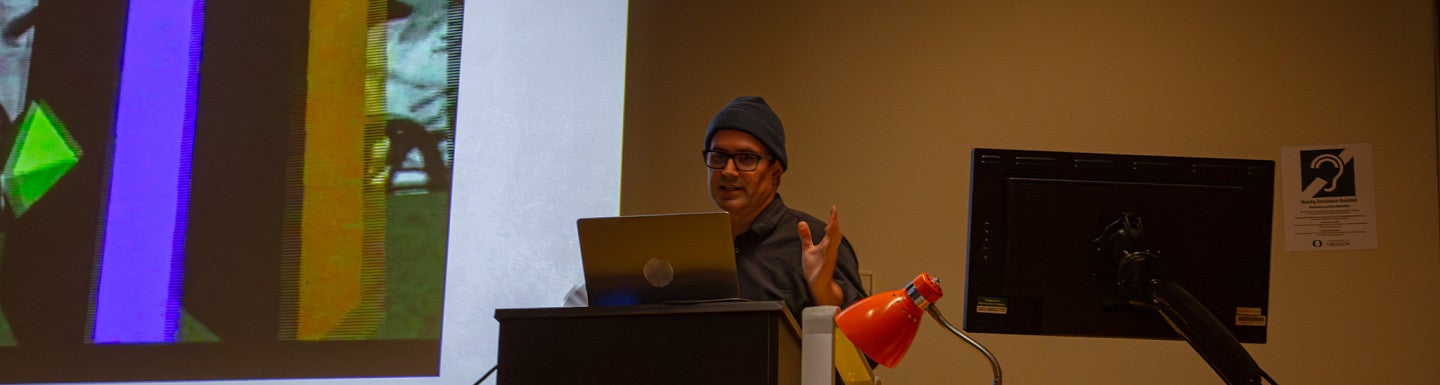
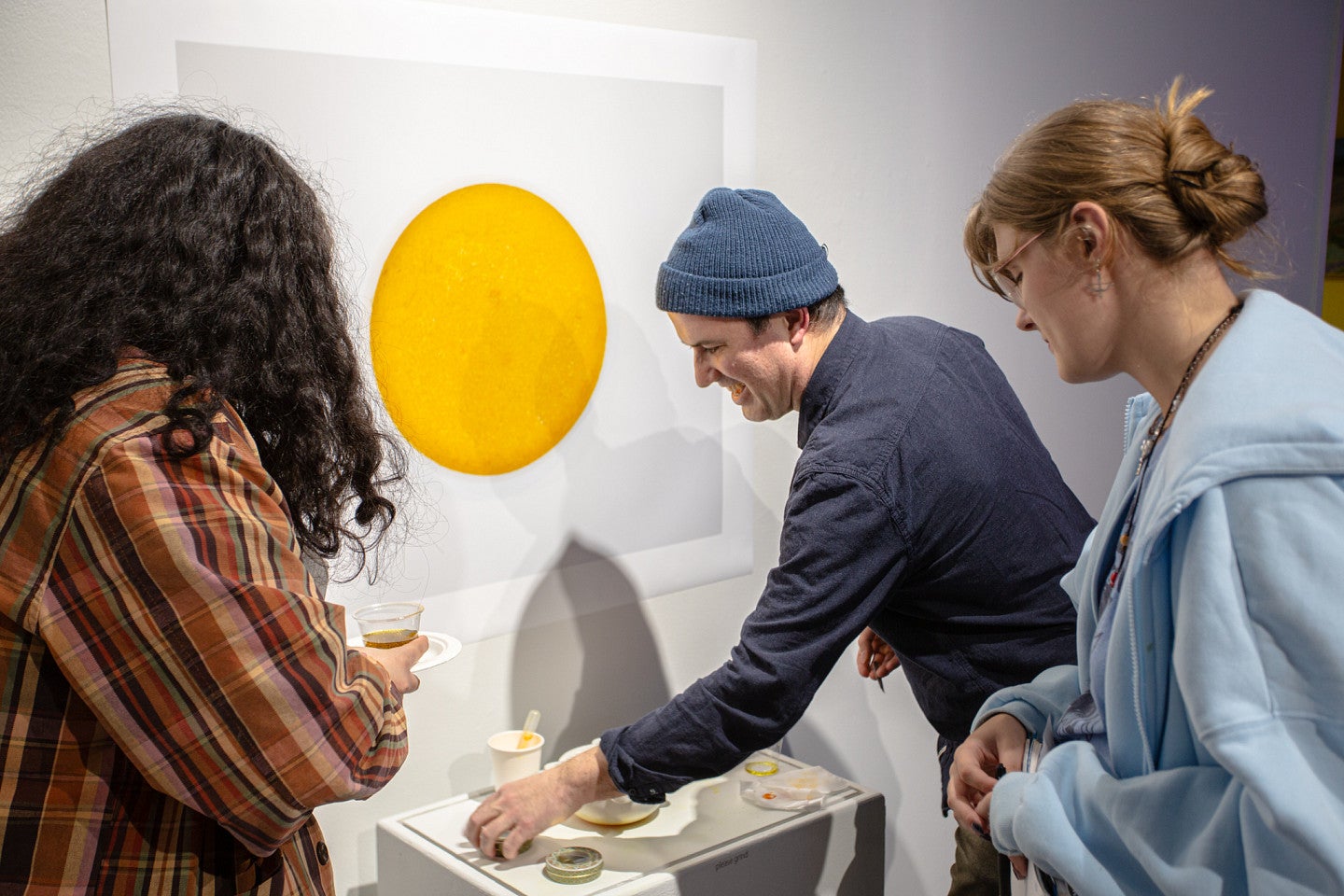
For Reza Safavi, MFA '06, the journey back to Eugene for his Visiting Artist Lecture gave the artist the chance to reminisce and explore his old stomping grounds. While the general shape of the building, Lawrence Hall, was the same, the little details changed. As he explored and reset his interactive piece in the LaVerne Krause Gallery (LVK), Safavi couldn't help but notice the welcome differences from the early aughts to now.
"It looks so different in here," remarked Safavi, gesturing to the LVK's floor as he refilled the saffron bowl for his interactive piece entitled Saffron. "It feels so much bigger and better [with that change.]"
Safavi's attention to detail is emblematic of the artist-alumnus who, thanks to the strength of the Department of Art's faculty and pedagogy, is comfortable continuing to push his research and practice whether exhibiting internationally and nationally solo or in collaboration. Safavi's artistic journey from Canada to Oregon to Washington represents one of the many winding paths an artist can take. Safavi was raised in Canada in the wake of the Multiculturalism Act of 1988, which enshrined the previous policy of recognizing multiculturalism as a defining characteristic of Canadian identity into a permanent legislative framework.
The enshrinement of this characteristic would give Canadians the space to celebrate and explore cultural identities, safely. As a half-Iranian whose father emigrated to Canada in the 60's, this was hugely impactful for Safavi who even today is able to explore his hybrid identity through his art, showcasing . He would start on the path to Eugene after earning his BFA from the University of Victoria, in Victoria, BC, Canada.
"It was an interesting time [in 2003]," said Safavi. "I was [completing] an undergrad in video, animation, interactive media, and photography, and we had some visiting artists come in and shock me... Mel Chin, Eduardo Kac and Steve Kurtz. Exposure to their ideas and multidisciplinary art/science based work inspired me to push boundaries and pursue research projects in art, science, and technology."
His exhibition, Binging on the Biome, in the LVK would be an additional example of the influence these artists would have on Safavi's artistic style. Those eye-opening experiences with visiting artists, the revolution of technology in the artistic space, and his Canadian upbringing would be foundational for his eventual flight to the City of Eugene and the University of Oregon. While there, Safavi would discover how to find one's artistic groove and style.
"You have to get out of your comfort zone," explained Safavi. "This also means forming good relationships with faculty and students to allow yourself to form that community [and support] to explore."
His time at the university was filled with excitement and experimentation as one of a select few JIRCs on campus. The JIRCs, an acronym that represented the first letter of each of a particular student artist's first name, were a lively community of artists who pushed each other to greater exploration and heights. It was a formative group for Safavi in his second year.
"It was in my second year when we founded the JIRCs, the first year had a bit of a different vibe, and we started to experiment and do a lot of performances with video and electronics and experimental spaces. [W]e even had a night at the local bar, John Henry's, where we used to do visuals there every other Saturday... [mixing] videos in real time. We used to take trips [together] and we would end making projects in the places where we went, at the dunes, in swimming pools, and we had a lot of fun together. [During this time] we kind of started wearing these jumpsuits and they never came off. It was like this look, this aesthetic, so we called it Jerk (JIRC) Style."
The work and exhibitions put on the JIRCs and the rest of his graduate cohort would be an incredible experience for Safavi, whose work over the next 20 years would be centered around the examination of how technology shapes experience. He would explore this research with a varied collection of work with sculpture, video, game engines, light, sound, drawing, performance, analog and digital devices, as well as elements of the natural world to create interactive experiences that highlight the interfaces, both macro and micro, among communities, technology, consciousness, and the environment. As he reflects on twenty years of research, iteration, and exploration, Safavi stressed the necessity of taking risks and exploring failure, especially when in a university setting thanks to the unique support you can receive while you figure things out.
"While you are here, [especially at the university], you need to make use of the many, many resources [here]. Take classes, connect with students, [and] connect with faculty." explained Safavi. "If you can do it, do it. Sometimes it will be hard, but you need to make use of all the opportunities and resources. Don't worry about failing, go beyond!"
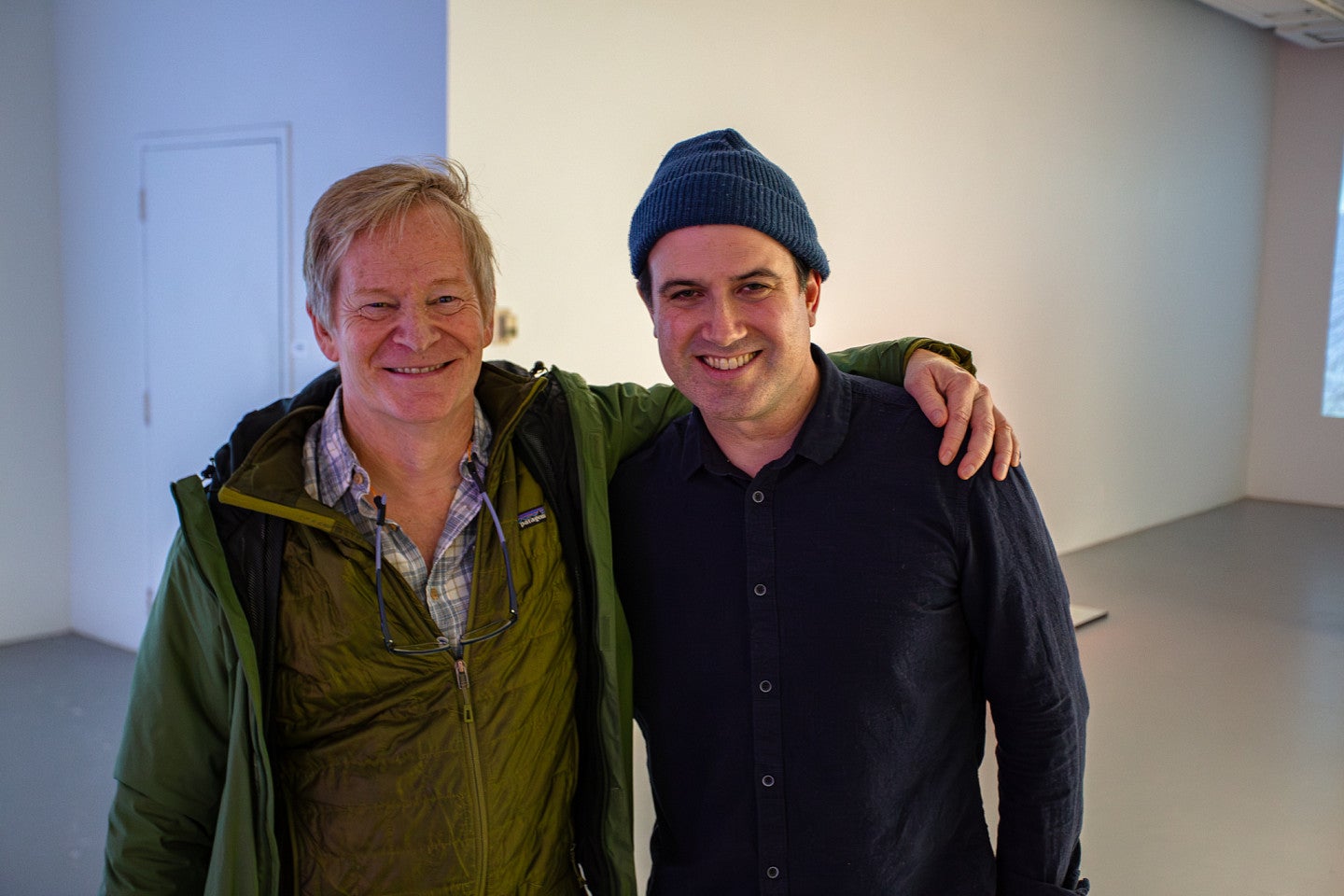
Safavi's story echoes other alumni tales, where they paint a picture of supportive and collaborative students and hard but fair faculty who help the students push through their boundaries to improve. The Master's in Fine Arts in Art (MFA) program, one of the University of Oregon's top four graduate programs and a 2026 US News and World Report top 35 MFA program, was a draw for Safavi, who was looking for a mix of affordability, a whole art program, and expert faculty.
"I wouldn't be here today if it wasn't for the faculty," explained Safavi. "Craig Hickman, Kartz Ucci, Amanda Wojick, Colin Ives, Dan Powell, and Michael Salter [were all important for me]. Kartz was [especially] wonderful and was hired when I was here. I got the chance to get to know her, and she was a great friend [until her death in 2013]."
In addition to being an alumnus of the University of Oregon's School of Art + Design, Safavi is a Professor and Director of Digital Media, in the Department of Art at Washington State University where he puts his extensive experience to service in teaching the next generation of artists. He continues to exhibit both internationally and nationally when not in the classroom.